PortGuardian Case Study

PortGuardian Enterprise SIEM Edition
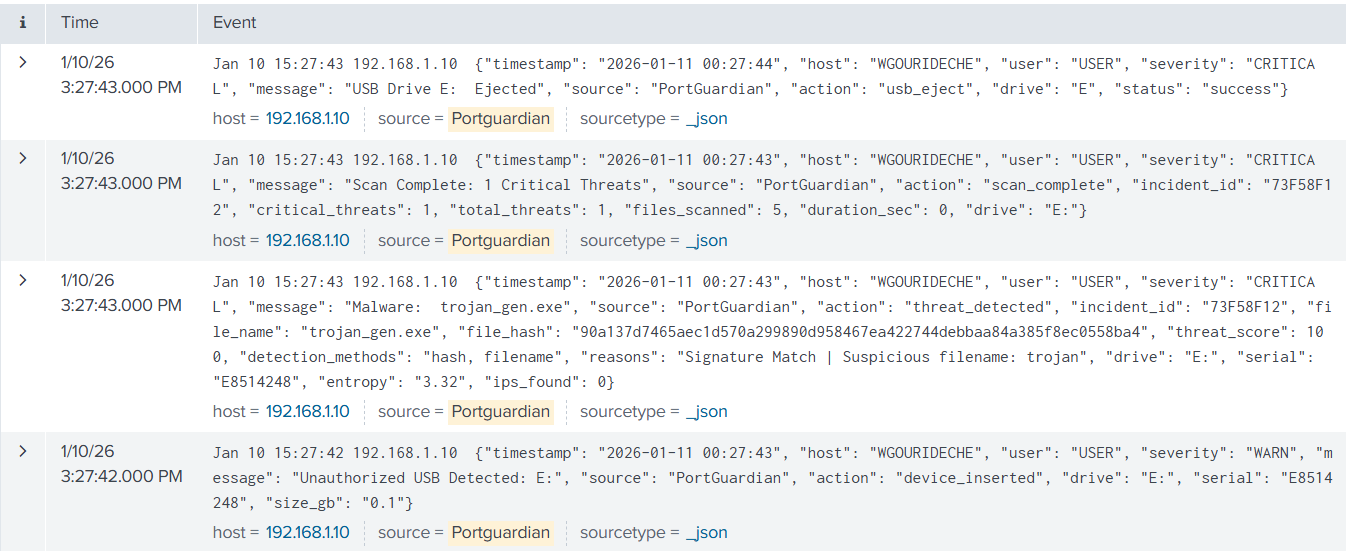
PortGuardian is a Windows endpoint agent tested in a VMware-based small-enterprise lab. It detects USB insertions, scans suspicious files locally with six checks, isolates the host on critical hits, and forwards only WARN and CRITICAL alerts to Splunk.
VMware virtual lab: 2 Windows 10 client VMs, 1 Windows Server 2019 Splunk VM at 192.168.1.50, 1 managed switch, 1 router/firewall, and a shared 192.168.1.0/24 VLAN.
Short Summary
PortGuardian follows a local-first response model. WMI detects new USB media, a six-layer engine scores the files, and the endpoint reacts before Splunk is involved. Only the alerts that need analyst attention are sent to the SIEM.
- Average USB detection time measured 350 ms in lab tests.
- The VMware lab uses 2 Windows 10 client VMs and 1 Windows Server 2019 Splunk VM.
- Only WARN and CRITICAL events go to 192.168.1.50 over Syslog UDP 514.
- Scores of 85 or more eject the USB device and isolate the endpoint in under 5 seconds.
Actual Lab Topology
This diagram shows the main path in the VMware lab: two Windows 10 client VMs send WARN and CRITICAL syslog events over the shared 192.168.1.0/24 subnet to the Splunk VM at 192.168.1.50.
Simple Schemas
The first schema zooms into the local scan and shows the six detection layers that build the final threat score.
These next three schemas show the core operating path from the report: USB detection, automatic response, and filtered forwarding to Splunk.
Proof and Validation
From USB insertion to detection in the lab.
From USB event to endpoint isolation.
998 of 1,000 test alerts were received in Splunk.
At this score, automatic isolation begins.